Tuesday, September 05, 2006
Iran Suppressing Freedom Again
Here we are again, with Iran's President trying to rub out any ideas of freedom in the country by trying to silence those who may encourage free thinking. This is the very definition of a dictatorship, keeping the people thinking only what you want them to so that you can control them.


Friday, June 30, 2006
The "Wasteprint" Concept
Lately as I've thought about the resources that we use, and how we use them, I've come up with a general concept cloud of ideas that I've started to call my "wasteprint" concept. The concept includes some of the following ideas:
-There are many resources on this planet which we can and do use. Some of them are more scarce than others, and some more used than others. But what do we actually "use" and what do we "waste" instead?
-Although that question will probably be a bit different for everybody, I think there are some generally accepted forms of waste: Stuff that goes in the landfill, electricity that we waste (like leaving lights on when we don't use them for anything), using excess gas in our cars, heating and/or cooling our homes inefficiently, etc.
-All resources that we use have been made available to us by God, our Creator, by whichever name one chooses to call him. As such, I think He is pleased when we use them wisely and correctly, and saddened when we waste them or use them for evil purposes. As such, the less we waste, the closer we can be to God.
You can think of a wasteprint as a footprint of waste. Or, how much impact does my individual waste make on the world around me? I may put up a web site to explore and define this concept further, as well as to solicit input from others around the world.
-There are many resources on this planet which we can and do use. Some of them are more scarce than others, and some more used than others. But what do we actually "use" and what do we "waste" instead?
-Although that question will probably be a bit different for everybody, I think there are some generally accepted forms of waste: Stuff that goes in the landfill, electricity that we waste (like leaving lights on when we don't use them for anything), using excess gas in our cars, heating and/or cooling our homes inefficiently, etc.
-All resources that we use have been made available to us by God, our Creator, by whichever name one chooses to call him. As such, I think He is pleased when we use them wisely and correctly, and saddened when we waste them or use them for evil purposes. As such, the less we waste, the closer we can be to God.
You can think of a wasteprint as a footprint of waste. Or, how much impact does my individual waste make on the world around me? I may put up a web site to explore and define this concept further, as well as to solicit input from others around the world.
Tuesday, June 13, 2006
Celebs Teach Ingratitude & Theft
CNN.com - Daryl Hannah removed from tree - Jun 13, 2006
This story really does reek of ingratitude. If the facts in this story are all accurate, which may or may not be the case, then all of these people who are illegally using this man's land should all be thrown in jail as trespassers.
So the guy has left his land vacant for 15 years, and people have gone there to grow vegetables, for free mind you. In fact, the land costs him $25,000 to $30,000 a year to own. Does he pass that on to the people who use his land? No. Does this suddenly mean that they have a RIGHT to any of the land? NO!
These freakshow socialist celebrities (Daryl Hannah, John Quigley, Willie Nelson, Danny Glover, Joan Baez, Julia Butterfly Hill) want to take away some guy's stuff (his land) to give it to people who are continuously breaking the law by being there and are ingrateful for the 15 years that he gave them for free. They are pathetic.
They (the celebs) have plenty of money. If they really cared that much, they could purchase that land or even other land or buildings nearby and then turn that land or buildings (after demolition) into a garden. Put all those celebrities together, with all their money, their connections, and all their fund-raising potential, and you could raise a good sum of money to buy that plot or another. But no, they would rather FORCE some other guy to give up his right to the land he bought and owns, rather than put up some of their own time and/or money for it. Good role models, these celebs... teach everyone that it is better to STEAL than to legally own, if you think you NEED it.
This story really does reek of ingratitude. If the facts in this story are all accurate, which may or may not be the case, then all of these people who are illegally using this man's land should all be thrown in jail as trespassers.
So the guy has left his land vacant for 15 years, and people have gone there to grow vegetables, for free mind you. In fact, the land costs him $25,000 to $30,000 a year to own. Does he pass that on to the people who use his land? No. Does this suddenly mean that they have a RIGHT to any of the land? NO!
These freakshow socialist celebrities (Daryl Hannah, John Quigley, Willie Nelson, Danny Glover, Joan Baez, Julia Butterfly Hill) want to take away some guy's stuff (his land) to give it to people who are continuously breaking the law by being there and are ingrateful for the 15 years that he gave them for free. They are pathetic.
They (the celebs) have plenty of money. If they really cared that much, they could purchase that land or even other land or buildings nearby and then turn that land or buildings (after demolition) into a garden. Put all those celebrities together, with all their money, their connections, and all their fund-raising potential, and you could raise a good sum of money to buy that plot or another. But no, they would rather FORCE some other guy to give up his right to the land he bought and owns, rather than put up some of their own time and/or money for it. Good role models, these celebs... teach everyone that it is better to STEAL than to legally own, if you think you NEED it.
Sunday, April 09, 2006
Immigration Rally in Salt Lake
Today there were quite a few marches and rallies across the country, including in Salt Lake City. For the most part, the demonstrators want fewer restrictions on immigration and citizenship for those already here illegally.
Me personally, I can't say that I agree. We live in a country that is only as great as it is because it runs based on the rule of law, in the form of a Republic. If we have a law on the books, we need to enforce it, or we need to get it off the books. Just because enough people are committing a certain crime doesn't mean we shouldn't prosecute them.
I saw today the story on TV of a man who was counter-protesting across the street from one such rally. He could see signs that people were holding saying things like, "I'm illegal, I work hard." He called up his local authorities and told them there were people openly admitting to being here illegally in front of city hall. They told him they were aware of the situation, but weren't going to do anything about it. How much more of a failure of our government can we have than that? If we had a bunch of pot smokers out there rallying to legalize marijuana, and one had a sign saying, "Look, I've got some marijuana right here, and I'm smoking it," then we'd have cops busting him on the spot. The law is the law. We cannot choose what we want to enforce and when. We must enforce all laws equally, and without bias.
I also feel that people who are here illegally are naturally predisposed to break the law more than those who come here legally. They break the law just to be here, and justify it saying they want a better life. Well, that's not very far from also saying that stealing from someone or from your employer is ok because that will help them get a better life. How about free medical care? That way they can have a better life, right? It is all about them having a better life, and they don't care about what that does to other people, or who pays for it. As long as they are going to get a better life, then they can say it is all ok.
We need to decide, as a country, on a simple, and easy to enforce set of immigration laws, then we need to put them in place. Once that is done, we need to put in place a STIFF penalty for an employer who has hired someone who is illegal. If an employer was forced to pay $50,000 for every illegal worker every time they hiring them, they would very soon lose the financial incentive to hire illegals. With that drastic drop in the hiring of illegals, they would soon realize that there is virtually no work here for them. Also, the ones who do manage to find work could be paid much less, and they would have much less incentive to try to stay here illegally. Don't try to stop the supply side of the equation, cut off the demand for illegal workers, and the supply will dwindle on its own.
Me personally, I can't say that I agree. We live in a country that is only as great as it is because it runs based on the rule of law, in the form of a Republic. If we have a law on the books, we need to enforce it, or we need to get it off the books. Just because enough people are committing a certain crime doesn't mean we shouldn't prosecute them.
I saw today the story on TV of a man who was counter-protesting across the street from one such rally. He could see signs that people were holding saying things like, "I'm illegal, I work hard." He called up his local authorities and told them there were people openly admitting to being here illegally in front of city hall. They told him they were aware of the situation, but weren't going to do anything about it. How much more of a failure of our government can we have than that? If we had a bunch of pot smokers out there rallying to legalize marijuana, and one had a sign saying, "Look, I've got some marijuana right here, and I'm smoking it," then we'd have cops busting him on the spot. The law is the law. We cannot choose what we want to enforce and when. We must enforce all laws equally, and without bias.
I also feel that people who are here illegally are naturally predisposed to break the law more than those who come here legally. They break the law just to be here, and justify it saying they want a better life. Well, that's not very far from also saying that stealing from someone or from your employer is ok because that will help them get a better life. How about free medical care? That way they can have a better life, right? It is all about them having a better life, and they don't care about what that does to other people, or who pays for it. As long as they are going to get a better life, then they can say it is all ok.
We need to decide, as a country, on a simple, and easy to enforce set of immigration laws, then we need to put them in place. Once that is done, we need to put in place a STIFF penalty for an employer who has hired someone who is illegal. If an employer was forced to pay $50,000 for every illegal worker every time they hiring them, they would very soon lose the financial incentive to hire illegals. With that drastic drop in the hiring of illegals, they would soon realize that there is virtually no work here for them. Also, the ones who do manage to find work could be paid much less, and they would have much less incentive to try to stay here illegally. Don't try to stop the supply side of the equation, cut off the demand for illegal workers, and the supply will dwindle on its own.
Monday, March 20, 2006
Warning Labels on Soda?
So now we have some nutritionists calling for warning labels on soda products. They say sodas are the leading cause of obesity. Give me a break!
They already have a warning label, and it is called "Nutrition Facts", just like every other food product in this country. Just because people choose to ignore it doesn't mean it needs a special label. Here's a couple reasons why:
Nutritionists say that 28% of what we drink is soda. Well, if 28% of what we ate was McDonald's or microwave dinners, we'd all be fat. But those are choices we all make. These products don't contain anything addictive or any carcinogens, like cigarettes. What's next, candy? Maybe pizza? Too much of almost anything is bad for you, but that doesn't mean we should put a label on it, or that it would help. People already know it is bad for them.
Putting all kinds of crazy warning labels on everything would quickly have the effect of desensitizing the population to such labels. Imagine right now looking at the store shelves and seeing the warning label on half the products out there. Are you going to care anymore? Nope. You already have nutrition facts on everything, and many people ignore that. So what makes someone think that anyone will be any more responsive to a warning label?
America's lifestyle contributes just as much as what they eat. I know people who work their butts off by running, going to the gym, etc. These people can eat whatever they want and not gain an ounce. They may not be getting all the vitamins they want, but they won't gain weight. I also know people who seem like they don't move off their couches and chairs but 5 times a day, usually to eat. These people are all fat and can't seem to do anything but gain weight.
Let's just keep giving people the facts and let them choose what they want. We can't force everyone to choose what we think is best.
They already have a warning label, and it is called "Nutrition Facts", just like every other food product in this country. Just because people choose to ignore it doesn't mean it needs a special label. Here's a couple reasons why:
Nutritionists say that 28% of what we drink is soda. Well, if 28% of what we ate was McDonald's or microwave dinners, we'd all be fat. But those are choices we all make. These products don't contain anything addictive or any carcinogens, like cigarettes. What's next, candy? Maybe pizza? Too much of almost anything is bad for you, but that doesn't mean we should put a label on it, or that it would help. People already know it is bad for them.
Putting all kinds of crazy warning labels on everything would quickly have the effect of desensitizing the population to such labels. Imagine right now looking at the store shelves and seeing the warning label on half the products out there. Are you going to care anymore? Nope. You already have nutrition facts on everything, and many people ignore that. So what makes someone think that anyone will be any more responsive to a warning label?
America's lifestyle contributes just as much as what they eat. I know people who work their butts off by running, going to the gym, etc. These people can eat whatever they want and not gain an ounce. They may not be getting all the vitamins they want, but they won't gain weight. I also know people who seem like they don't move off their couches and chairs but 5 times a day, usually to eat. These people are all fat and can't seem to do anything but gain weight.
Let's just keep giving people the facts and let them choose what they want. We can't force everyone to choose what we think is best.
Saturday, March 18, 2006
Cost of Housing Prisoners
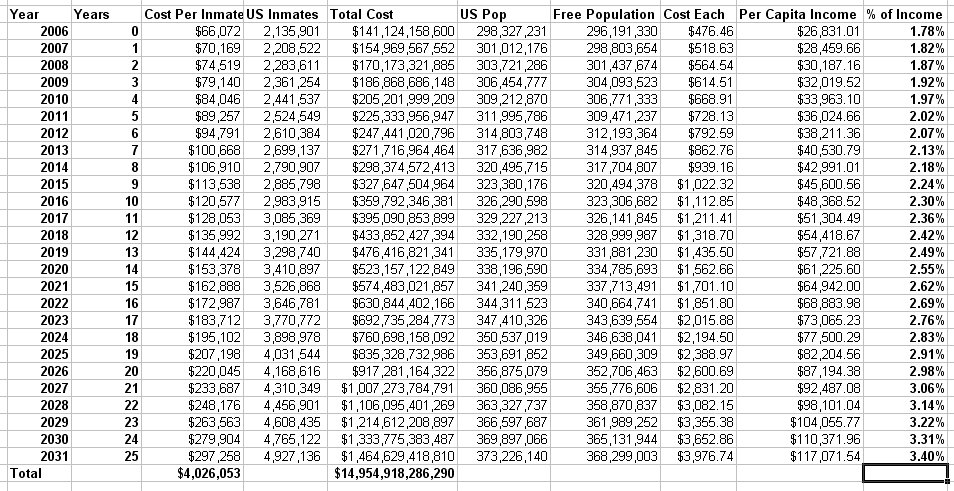
The prison system doesn't work. It is too cushy for prisoners, and costs taxpayers way too much. The government statistics I could find say that in 2005 there were 2,135,901 prisoners locked up in all federal, state, and local prisons, and that the long-term increase rate was 3.4% annually for prisoners in the system. The same federal statistics also said that in 2001 it cost an average of $134 a day for each state prisoner to house, feed, supervise, give medical care to, etc. It also said that the long-term average increase of those costs per prisoner were increasing at a rate of about 6.2% per year, about twice the rate of inflation. That would mean that this year it will cost about $181 a day to supervise an average state prisoner. Multiply the cost by the number and you get $141 billion spent by the federal government, all state governments, and all local governments. With 296,191,330 people in the US today and 2,135,901 of them in jail, that leaves 296,191,330 free men, women, and children in the country to each pay $476.46 this year alone for housing and supervising and feeding and giving medical care to those prisoners. That is 1.78% of the per capita (every man, woman and child in the entire country) income of Americans for this year.
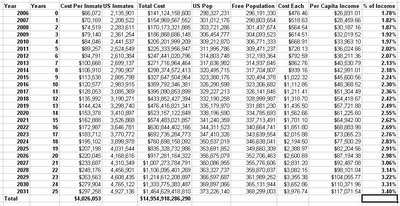
The worst part though, is that while inflation really is only about 3% a year, the cost per inmate is increasing by 6.2% per year, and the number of prisoners is growing at a rate of 3.4% per year while the US population is only growing by 0.9% per year, so the percentage of prisoners is getting higher. I put together a spreadsheet with all this data and the increase rates for the next 25 years, and it is very disturbing. If current rates that I found hold up over the next 25 years, then in 2031 it will cost $297,000 a year to take care of a prisoner, there will be almost 5 million prisoners, the total cost will be almost $1.5 trillion for that year, which will result in a cost per capita in the US of $3,976.74, or 3.4% of per capita in come, as compared to 1.78% today.
No, we need to trim down prisons, make them a punishment, not a benefit. There are too many people who don't care if they go back. Some people even commit crimes just to go back because it is a roof and 3 square meals they don't have to work for. Prison time should be hard, and uncomfortable, and unpleasant. The cost to taxpayers should be MINIMAL. Right now, we're not deterring crime with our prisons, which is why we are getting more of it. When people are afraid to go to prison, they think much harder about committing a crime. Think Soviet-era gulags here, but without the torture. Think small, basic solitary cells, basic food, no recreational facilities, TVs or the like. Almost no communication with other inmates or guards. Visiting days come once a month rather than once a week. Exercise time is spent alone, in a small courtyard. Meals are served in the cells, and they will be small (but healthy), as you don't need too much energy to sit around your cell all day. Approved books from a small collection in the prison is your only recreation in the cell, and these would all be educational books about real-life skills. Too many people don't have a fear of going to prison. We need to re-establish prisons as a deterrent, not as a convenient motel when you don't want to work.
The worst part though, is that while inflation really is only about 3% a year, the cost per inmate is increasing by 6.2% per year, and the number of prisoners is growing at a rate of 3.4% per year while the US population is only growing by 0.9% per year, so the percentage of prisoners is getting higher. I put together a spreadsheet with all this data and the increase rates for the next 25 years, and it is very disturbing. If current rates that I found hold up over the next 25 years, then in 2031 it will cost $297,000 a year to take care of a prisoner, there will be almost 5 million prisoners, the total cost will be almost $1.5 trillion for that year, which will result in a cost per capita in the US of $3,976.74, or 3.4% of per capita in come, as compared to 1.78% today.
No, we need to trim down prisons, make them a punishment, not a benefit. There are too many people who don't care if they go back. Some people even commit crimes just to go back because it is a roof and 3 square meals they don't have to work for. Prison time should be hard, and uncomfortable, and unpleasant. The cost to taxpayers should be MINIMAL. Right now, we're not deterring crime with our prisons, which is why we are getting more of it. When people are afraid to go to prison, they think much harder about committing a crime. Think Soviet-era gulags here, but without the torture. Think small, basic solitary cells, basic food, no recreational facilities, TVs or the like. Almost no communication with other inmates or guards. Visiting days come once a month rather than once a week. Exercise time is spent alone, in a small courtyard. Meals are served in the cells, and they will be small (but healthy), as you don't need too much energy to sit around your cell all day. Approved books from a small collection in the prison is your only recreation in the cell, and these would all be educational books about real-life skills. Too many people don't have a fear of going to prison. We need to re-establish prisons as a deterrent, not as a convenient motel when you don't want to work.
Sunday, February 19, 2006
Taxes on those who can't do math.
Many people in this country play the lottery, hoping beyond all hope that they will win a big prize. The lottery in this linked story pays out $365 million over time to a single winner. But your odds of winning are about 1 in 146 million. How bad are those odds? Well, let's take some examples having to do with your untimely demise as a US resident (stats found at http://www.nsc.org/lrs/statinfo/odds.htm):
Your odds of dying unexpectedly due to an accident or injury are 1 in 2698, each year! They are 1 in 35 for your entire lifetime! But your chance of dying by accident this year is still more than 54,000 times more likely than your winning the lottery.
You are 16051 times more likely to commit suicide than to win the lottery (probably from wasting all your money on that lottery in the first place).
You are 24,525 times more likely to die in some kind of transport or vehicle accident than to win the lottery.
You are 8,943 times more likely to be killed by a violent assault than to win the lottery.
You are 1,748 times more likely to die by drowning than to win the lottery.
You are 1,602 times more likely to die in a fire than to win the lottery.
You are 180 times more likely to pass out and die from drinking too much alcohol than you are to win the lottery.
You are 33 times more likely to be killed by lightning than to win the lottery.
You are 20 times more likely to die from contact with hot tap water.
You are 16 times more likely to be killed in an earthquake than to win the lottery.
You are 5.07 times more likely to die of a poisonous spider bite than to win the lottery.
You are 2.54 times more likely to be killed by a fireworks discharge than to win the lottery.
So, with all these examples before us, why not spend that same money on an insurance policy? Seems like you have a much better chance on your family collecting on it if you die (or you collecting on your spouse's if he/she dies) than of winning the lottery.
Many lottery players routinely spend $50 a month on lottery tickets. If they started, at age 21, putting that $50 a month into an investment account (with an average long-term market return of 10%) rather than playing the lottery with it, and did so until they retired at age 65, they would have a tidy sum of almost $474,000 in that account. With that amount and that rate of return, they could withdraw $4,000 a month FOR EVER and never drain that account. That means their entire retirement and for the entire lives of their children and grandchildren, etc.
But, in the end, lottery is pushed by states because they make a nice percentage off the ticket sales. So the people who have a 100% chance of winning the lottery are the state governments, and the company putting on the lottery. Let's see... sounds like a tax on people who can't do math. Hmmm... 1 in 146 million chance, or 1 in 1 chance, which do I prefer more?
Your odds of dying unexpectedly due to an accident or injury are 1 in 2698, each year! They are 1 in 35 for your entire lifetime! But your chance of dying by accident this year is still more than 54,000 times more likely than your winning the lottery.
You are 16051 times more likely to commit suicide than to win the lottery (probably from wasting all your money on that lottery in the first place).
You are 24,525 times more likely to die in some kind of transport or vehicle accident than to win the lottery.
You are 8,943 times more likely to be killed by a violent assault than to win the lottery.
You are 1,748 times more likely to die by drowning than to win the lottery.
You are 1,602 times more likely to die in a fire than to win the lottery.
You are 180 times more likely to pass out and die from drinking too much alcohol than you are to win the lottery.
You are 33 times more likely to be killed by lightning than to win the lottery.
You are 20 times more likely to die from contact with hot tap water.
You are 16 times more likely to be killed in an earthquake than to win the lottery.
You are 5.07 times more likely to die of a poisonous spider bite than to win the lottery.
You are 2.54 times more likely to be killed by a fireworks discharge than to win the lottery.
So, with all these examples before us, why not spend that same money on an insurance policy? Seems like you have a much better chance on your family collecting on it if you die (or you collecting on your spouse's if he/she dies) than of winning the lottery.
Many lottery players routinely spend $50 a month on lottery tickets. If they started, at age 21, putting that $50 a month into an investment account (with an average long-term market return of 10%) rather than playing the lottery with it, and did so until they retired at age 65, they would have a tidy sum of almost $474,000 in that account. With that amount and that rate of return, they could withdraw $4,000 a month FOR EVER and never drain that account. That means their entire retirement and for the entire lives of their children and grandchildren, etc.
But, in the end, lottery is pushed by states because they make a nice percentage off the ticket sales. So the people who have a 100% chance of winning the lottery are the state governments, and the company putting on the lottery. Let's see... sounds like a tax on people who can't do math. Hmmm... 1 in 146 million chance, or 1 in 1 chance, which do I prefer more?
Tuesday, January 31, 2006
The Chains of Debt
The lure of easy money now and a payment date that seems far away into the future is quietly but efficiently gaining ground in the war for the souls of men. That great dungeon master, debt, is binding more and more people to a life of slavery every day. The debt of individuals, companies, and governments alike is reaching staggering levels.
In October of 2004, USA Today reported that $84,454 is the average household's personal debt and $473,456 is the average household's share of government debt, including Medicare and Social Security. In Fiscal Year 2005 alone the US federal government accrued $352.3 billion in interest on outstanding debt! That's over $1000 of interest for every man, woman, and child in this entire country.
Debt can be a crushing force, robbing us of our freedoms to do that which we please, and chaining us to our obligations. The following is a story from a Yahoo Finance article:
"It took William R. Love a full decade to get through college, mostly because he kept quitting to make what money he could at places like Burger King and Friendly's Ice Cream. Then, when he finally graduated from Rochester Institute of Technology in 2002, he couldn't find a decent job. His wife, Jessica, pressured him to take whatever he could find, and eventually he did. But he begrudged her; she was disappointed in him. A year later their marriage collapsed.
Now, at age 31, he is about to finish his master's degree in business at RIT. William is charming and highly capable and has lots of ideas about what he might do. He thought of moving to Chicago, a city he regards as full of promise. But he's realizing that to secure the $70,000-a-year job he hopes for, he has to be willing to go pretty much anywhere. He would, though, like to stay within driving distance of his parents, who live in rural Pennsylvania; money for plane tickets home may be hard to come by. William knows he will have to live frugally for years so that he can pay off the $71,000 he owes in student loans and the $40,000 balance on his credit cards.
William lives with his girlfriend, Savita Thakur, who is a 28-year-old technical writer and part-time student in the same MBA program. But he won't be in a position to get married, have children, or buy a house for a long, long while. 'I have to meet my financial goals to pursue my career properly. I can't take on more debt and do that,' he says. In this, he is not alone: Fourteen percent of graduates said in 2002 that they had delayed marriage because of their loan obligations, compared with 9% in 1987. (Young and Broke: Your Money - Yahoo! Finance)"
Like William, many have crushing levels of debt, which forces them to make choices they wouldn't normally make if they could avoid them. In this case, he and his girlfriend are putting off marriage, children, and a house because of the debt. Are these people really free to do what they wish? Not really. They are essentially locked away in a prison of their own making, performing slave labor for those who get rich off their interest payments. The lenders are the masters, the debtors are the slaves. Debt is a form of bondage. We think we own things, but in reality, our things own us.
I dread the grave consequences that, I fear, must come to pass when the already crushing weight of all this personal, corporate, and governmental debt comes crashing down on all of us. The great economic and personal tragedy that will result will have horrible effects upon society as we know it. The great stock market crash of 1929 was precipitated by high levels of debt in stocks. I fear that the high levels of debt in life will bring an economic crash the likes of which we have never seen before. My advice: Get out of as much debt as possible, as soon as possible, and start putting away a year's worth of food and emergency supplies (as we already should be doing).
In October of 2004, USA Today reported that $84,454 is the average household's personal debt and $473,456 is the average household's share of government debt, including Medicare and Social Security. In Fiscal Year 2005 alone the US federal government accrued $352.3 billion in interest on outstanding debt! That's over $1000 of interest for every man, woman, and child in this entire country.
Debt can be a crushing force, robbing us of our freedoms to do that which we please, and chaining us to our obligations. The following is a story from a Yahoo Finance article:
"It took William R. Love a full decade to get through college, mostly because he kept quitting to make what money he could at places like Burger King and Friendly's Ice Cream. Then, when he finally graduated from Rochester Institute of Technology in 2002, he couldn't find a decent job. His wife, Jessica, pressured him to take whatever he could find, and eventually he did. But he begrudged her; she was disappointed in him. A year later their marriage collapsed.
Now, at age 31, he is about to finish his master's degree in business at RIT. William is charming and highly capable and has lots of ideas about what he might do. He thought of moving to Chicago, a city he regards as full of promise. But he's realizing that to secure the $70,000-a-year job he hopes for, he has to be willing to go pretty much anywhere. He would, though, like to stay within driving distance of his parents, who live in rural Pennsylvania; money for plane tickets home may be hard to come by. William knows he will have to live frugally for years so that he can pay off the $71,000 he owes in student loans and the $40,000 balance on his credit cards.
William lives with his girlfriend, Savita Thakur, who is a 28-year-old technical writer and part-time student in the same MBA program. But he won't be in a position to get married, have children, or buy a house for a long, long while. 'I have to meet my financial goals to pursue my career properly. I can't take on more debt and do that,' he says. In this, he is not alone: Fourteen percent of graduates said in 2002 that they had delayed marriage because of their loan obligations, compared with 9% in 1987. (Young and Broke: Your Money - Yahoo! Finance)"
Like William, many have crushing levels of debt, which forces them to make choices they wouldn't normally make if they could avoid them. In this case, he and his girlfriend are putting off marriage, children, and a house because of the debt. Are these people really free to do what they wish? Not really. They are essentially locked away in a prison of their own making, performing slave labor for those who get rich off their interest payments. The lenders are the masters, the debtors are the slaves. Debt is a form of bondage. We think we own things, but in reality, our things own us.
I dread the grave consequences that, I fear, must come to pass when the already crushing weight of all this personal, corporate, and governmental debt comes crashing down on all of us. The great economic and personal tragedy that will result will have horrible effects upon society as we know it. The great stock market crash of 1929 was precipitated by high levels of debt in stocks. I fear that the high levels of debt in life will bring an economic crash the likes of which we have never seen before. My advice: Get out of as much debt as possible, as soon as possible, and start putting away a year's worth of food and emergency supplies (as we already should be doing).
Tuesday, November 22, 2005
Minimum Wage
The government regulates the labor market by setting a minimum wage that firms must pay their workers. So is a minimum wage worth it? It has the same effect as a price floor on a product. If the equilibrium wage is higher than the minimum wage (price floor), then the minimum wage has no discernable effect on the market, since the equilibrium point will be above the minimum wage. If the equilibrium wage is below the minimum wage, however, then there will be a surplus of labor: at the artificially high minimum wage, demand for labor is lower than supply, meaning that there will be unemployment (surpluses of labor). In this situation, not every worker who is willing to work for the minimum wage will be able to find a firm who wants to hire them.
There are strong arguments for either side. On one hand, if the minimum wage were removed, there might be lower unemployment, but workers might not make enough money to support themselves and their families. On the other hand, with the minimum wage in place, the employed are able to make more money, but many more workers are forced into unemployment and forced to take welfare, while making no contribution towards national productivity.
Whom does the minimum wage hurt the most? Firms will always want skilled workers who can make large contributions to productivity. When the minimum wage is installed, however, it is the least productive workers who are cut from payrolls first. The skilled workers will keep their jobs, perhaps even with higher pay; but the unskilled workers, because their marginal revenue product is lower than the new minimum wage, will be unemployed. The irony of the situation is that most people who advocate a higher minimum wage are hoping to help out the workers at the bottom of the ladder, when in reality, a higher minimum wage could very well put those workers out of a job.
My Opinion: The government should not be telling people what they can and cannot pay an employee. Let the market forces work it out without installing artificial price floors.
There are strong arguments for either side. On one hand, if the minimum wage were removed, there might be lower unemployment, but workers might not make enough money to support themselves and their families. On the other hand, with the minimum wage in place, the employed are able to make more money, but many more workers are forced into unemployment and forced to take welfare, while making no contribution towards national productivity.
Whom does the minimum wage hurt the most? Firms will always want skilled workers who can make large contributions to productivity. When the minimum wage is installed, however, it is the least productive workers who are cut from payrolls first. The skilled workers will keep their jobs, perhaps even with higher pay; but the unskilled workers, because their marginal revenue product is lower than the new minimum wage, will be unemployed. The irony of the situation is that most people who advocate a higher minimum wage are hoping to help out the workers at the bottom of the ladder, when in reality, a higher minimum wage could very well put those workers out of a job.
My Opinion: The government should not be telling people what they can and cannot pay an employee. Let the market forces work it out without installing artificial price floors.
Monday, November 21, 2005
Federal Pork on its way to Utah
"OREM, Utah (AP) -- A section of Alpine Loop would get a $2 million study in a federal spending bill agreed to by House and Senate negotiators on Friday.
The bill would bring $21 million in federal spending to Utah, and Rep. Chris Cannon, R-Utah, said that $6.3 million of that is for his 3rd district, which covers parts of central and western Utah.
The House passed the measure 392-31. If approved by the Senate and signed by President Bush, it would bring:
-- $600,000 to Provo for the city's new performing arts center,
-- $500,000 to Orem to widen Geneva Road from 1600 North to University Parkway
-- $200,000 to Eagle Mountain for community development and park improvements."
Now, as much as I like freebies, this is one I'd rather not be getting (not least of all because it isn't actually a freebie). I don't like the idea of every American's tax dollars paying for a road that only we in this area use. And I really don't like the idea of every American's tax dollars paying for a performing arts center in Provo and for "community development and park improvements" in Eagle mountain.
The sad part is that this is exactly the kind of government spending that happens all over the place all the time. My tax dollars are probably paying for some performing arts center in Iowa and a bunch of parks in California. These aren't things I will ever use, so why should I pay for them? Conversely, the people of Iowa and California won't ever be using the parks in Eagle Mountain or the performing arts center in Provo, so why should they pay for them?
The underlying issue really is, why are people being forced to pay for these services at all unless they are actually using them? Should the government be allowed to essentially steal money from people to pay for these things? Why can't these things be paid for directly by those who use them? Why does the government have to decide which services we the people "need" and should all be forced to pay for?
Sadly, the answers to those questions are probably too simple, which is why the government and the people of this country can't figure them out.
The bill would bring $21 million in federal spending to Utah, and Rep. Chris Cannon, R-Utah, said that $6.3 million of that is for his 3rd district, which covers parts of central and western Utah.
The House passed the measure 392-31. If approved by the Senate and signed by President Bush, it would bring:
-- $600,000 to Provo for the city's new performing arts center,
-- $500,000 to Orem to widen Geneva Road from 1600 North to University Parkway
-- $200,000 to Eagle Mountain for community development and park improvements."
Now, as much as I like freebies, this is one I'd rather not be getting (not least of all because it isn't actually a freebie). I don't like the idea of every American's tax dollars paying for a road that only we in this area use. And I really don't like the idea of every American's tax dollars paying for a performing arts center in Provo and for "community development and park improvements" in Eagle mountain.
The sad part is that this is exactly the kind of government spending that happens all over the place all the time. My tax dollars are probably paying for some performing arts center in Iowa and a bunch of parks in California. These aren't things I will ever use, so why should I pay for them? Conversely, the people of Iowa and California won't ever be using the parks in Eagle Mountain or the performing arts center in Provo, so why should they pay for them?
The underlying issue really is, why are people being forced to pay for these services at all unless they are actually using them? Should the government be allowed to essentially steal money from people to pay for these things? Why can't these things be paid for directly by those who use them? Why does the government have to decide which services we the people "need" and should all be forced to pay for?
Sadly, the answers to those questions are probably too simple, which is why the government and the people of this country can't figure them out.
Subscribe to:
Posts (Atom)