Read the story on CNN.com
Is it finally possible to make a "quiet" supersonic jet? The folks at Lockheed Martin's fabled Skunk Works think they've designed just such an aircraft.
With advanced design and technology, they believe they have designed a plane that can cruise at about 1100 MPH, while producing only 1 percent as much noise on the ground as the recently decommissioned Concorde. All this while obtaining considerable range (4,600 miles, Chicago to Rome), and some fairly fine luxury seating.
I for one hope that they succeed. I hope that this spurs the development of affordable and quiet supersonic passenger jets. For the last 50 years, passenger planes have gone the same speed. We have not realized any gains in the speed with which we travel through the air, despite 50 years of technology evolution. It is definitely time to move around the planet faster.
Tuesday, February 20, 2007
Friday, February 16, 2007
Irresponsable Media
There have been many stories in the news lately, as there always are, about world events. But in recent weeks, one story has consistently made headlines more than any other.
It concerned the death of a woman named Vickie Lynn Marshall. She grew up in Texas, with several half-siblings, in a broken home. She moved in with her aunt, and failed miserably in school, never gaining more than an 8th grade education. She decided at the age of 17 to marry a 16-year old boy and then have a child. The two seperated a year after the child was born, and she started to work at Wal-Mart, and then as a waitress at Red Lobster.
She apparently didn't like working for low wages, and decided to become a stripper. But she got a "big break" in 1992 when she got in to Playboy Magazine. She married an old billionaire, who died 13 months later, leaving her a fortune. She had a daughter by some other unknown person in 2006. Later in 2006, her son, who was a recovering druggie, died at age 20 from a combination of drug-addiction medications and anti-depressants. She finally died this year at age 39, from as-yet unknown causes. Heavy drug and alcohol use are suspected as possible culprits, as having shortened her life.
By now, you may have realized that I'm speaking about Anna Nicole Smith. Just about anyone who has read the newspapers or seen the internet has seen countless stories about her death in recent weeks.
But why is the press (and through them the American People) so intent on dwelling on this particular life? Why is it that the press puts so much attention on a stripper who one could argue has done nothing constructive for the world? Many would argue that this was a miserable failure of a human being who got lucky enough to look good nude. Many would say that she never contributed anything to society, but that she in fact helped pull society downward, and destroy value more than create value.
The sad fact of the matter is that the media loves to dwell on people like Anna Nicole Smith, and get the public to dwell on it, because of the nature of lust and greed. The really great people of the world (of whom there are many), are rarely mentioned in the press. And even when they are, it is only a quick and fleeting story, printed once and then forgotten. How many Nobel Prize winners can the average American name? How many great, ordinary, every day people who sacrifice and help those around them, are mentioned on the news when they die? How many good examples are mourned by the media today, when they pass, compared to the bad examples who only destroy our society and everything around them?
Shame on the media, for systematically destroying our values, and our society.
It concerned the death of a woman named Vickie Lynn Marshall. She grew up in Texas, with several half-siblings, in a broken home. She moved in with her aunt, and failed miserably in school, never gaining more than an 8th grade education. She decided at the age of 17 to marry a 16-year old boy and then have a child. The two seperated a year after the child was born, and she started to work at Wal-Mart, and then as a waitress at Red Lobster.
She apparently didn't like working for low wages, and decided to become a stripper. But she got a "big break" in 1992 when she got in to Playboy Magazine. She married an old billionaire, who died 13 months later, leaving her a fortune. She had a daughter by some other unknown person in 2006. Later in 2006, her son, who was a recovering druggie, died at age 20 from a combination of drug-addiction medications and anti-depressants. She finally died this year at age 39, from as-yet unknown causes. Heavy drug and alcohol use are suspected as possible culprits, as having shortened her life.
By now, you may have realized that I'm speaking about Anna Nicole Smith. Just about anyone who has read the newspapers or seen the internet has seen countless stories about her death in recent weeks.
But why is the press (and through them the American People) so intent on dwelling on this particular life? Why is it that the press puts so much attention on a stripper who one could argue has done nothing constructive for the world? Many would argue that this was a miserable failure of a human being who got lucky enough to look good nude. Many would say that she never contributed anything to society, but that she in fact helped pull society downward, and destroy value more than create value.
The sad fact of the matter is that the media loves to dwell on people like Anna Nicole Smith, and get the public to dwell on it, because of the nature of lust and greed. The really great people of the world (of whom there are many), are rarely mentioned in the press. And even when they are, it is only a quick and fleeting story, printed once and then forgotten. How many Nobel Prize winners can the average American name? How many great, ordinary, every day people who sacrifice and help those around them, are mentioned on the news when they die? How many good examples are mourned by the media today, when they pass, compared to the bad examples who only destroy our society and everything around them?
Shame on the media, for systematically destroying our values, and our society.


Wednesday, November 08, 2006
Elections - 2006
Voters went to the polls to cast their ballots yesterday. I, for one, did not. I cast my vote on October 27th, during early voting. This is because I would be spending all of election day (6 AM to 9 PM) working as a poll worker.
Why did I sign up? Several reasons. First, I wanted to help out. I had seen that in several places in Utah there was a shortage of poll workers. I felt like I was in a position to help, as I am able to take time off work more easily than some, and duty-bound to do so. Second, I wanted to get an up-close view of the voting process. I've always voted in every election. But, like many voters, my experience consisted of going to the polls and voting, and then going home. I wanted to see the details, understand what is happening, and understand how robust our voting process is.
What was it like? It was a lot of work! I was one of 7 dedicated and hard-working poll workers in my location, setting up and running 10 new voting machines for the 3 precincts that voted at that location. I spent much of the day helping people to cast provisional ballots. That's where someone comes in, thinks they are registered in the precinct, lives in it, but isn't in the register. In such a case, we establish their identification and that their current address is in the precinct (using the ID or bills they get at their address), and then give them a paper ballot to vote on. These ballots will be looked at individually at a later date by the county, to decide if they count.
We did some rotating of jobs so that everyone did most jobs they wanted to throughout the day. We took people's names, encoded voting cards for them, explained the machines to them, helped them when they had problems, etc. Our compensation for 15 hours of work? $80. Here are some conclusions/impressions drawn from my experience yesterday:
TOO FEW PEOPLE VOTE - In our precincts we had 2716 names listed on the register. We had a total of 416 regular and provisional voters throughout the day. There were another 50 or so on a list we were given of people who were in the register, but who had voted early or absentee. That's a pretty low turnout if you look at it that way. But really, I think that the number of people in the register is too high. More about that later. I think we as a society focus too much on voting as a right and a privilege, and not enough on voting as a duty.
PEOPLE ARE VERY UNINFORMED - From my interaction with several hundred voters, it seems like most people are uninformed to one degree or another. Some voters knew most of the things they cast votes for. But many were totally oblivious. We had people who came in and got to the machine and asked us who to vote for. Of course, we couldn't help them decide that, but it was eye-opening. Many expressed vocally that they were here to do their duty (mainly the elderly), but didn't really know anything about any of the candidates, so they were just going to vote by party, knowing nothing about the candidates and almost nothing about the party. The number of business professionals that I saw come in was much lower than the elderly or the college students. Did these people vote early? Who knows. But I have a lot less confidence now in the voters' decisions due to the massive amounts of ignorance I saw at the polls.
THE PROCESS IS STILL CUMBERSOME - Despite the new voting machines, which I think were an improvement over paper, the process of voting is still very old-fashioned and cumbersome. As a voter you walk in and (if you haven't had to wait in line too long) soon meet a register clerk. This clerk asks your name and looks you up in the register. In 99% of cases you don't have to show ID. As long as you said that is your name, you can vote. You sign the register and move on to the poll book. A poll worker then asks your name and writes it down in the poll book. He/she then tells the register clerk which number voter you are for the day, and the register clerk writes that number down next to your signature. Once that is done, you move to the ballot clerk, who encodes a ballot card with your precinct number and hands it to you. At this point you can start voting. This process is much longer if you're not in the book and need to vote provisionally. This process is also, in my opinion, very easy to fool in order to commit fraud. Realistically, we can do all that and more with a computerized system and only 1 or 2 workers rather than 4 or 5.
POTENTIAL FOR FRAUD - The new voting machines are, I believe, much less succeptible to fraud. However, it would still be an easy matter to get names out of the poll books and have others vote there as someone else. Or, someone could easily vote in a district they no longer live in. The fraud potential is biggest where there is the most human and register interaction. The registers need to be updated more aggressively than they are now. We should all at some point be required to show proof that we are who we say we are, and that we still live where we do.
INCONVENIENCE - The new early voting is a nice upgrade to allow people to vote more conveniently. But I would like to see that kind of thing expanded. Why not expand the number of early-voting locations? Even if early-voting is only open for a week or so before the election, having several key early voting areas around the city would really speed up everything on election night, and allow a county to have fewer machines to worry about.
I still believe in the right of the people to cast their votes for what they believe in. But when I see the potential for fraud, the cumbersome nature of the process, and the ignorance displayed by many voters, I fear for what kind of decisions are being made by the people as a whole when they come to the polls.
Why did I sign up? Several reasons. First, I wanted to help out. I had seen that in several places in Utah there was a shortage of poll workers. I felt like I was in a position to help, as I am able to take time off work more easily than some, and duty-bound to do so. Second, I wanted to get an up-close view of the voting process. I've always voted in every election. But, like many voters, my experience consisted of going to the polls and voting, and then going home. I wanted to see the details, understand what is happening, and understand how robust our voting process is.
What was it like? It was a lot of work! I was one of 7 dedicated and hard-working poll workers in my location, setting up and running 10 new voting machines for the 3 precincts that voted at that location. I spent much of the day helping people to cast provisional ballots. That's where someone comes in, thinks they are registered in the precinct, lives in it, but isn't in the register. In such a case, we establish their identification and that their current address is in the precinct (using the ID or bills they get at their address), and then give them a paper ballot to vote on. These ballots will be looked at individually at a later date by the county, to decide if they count.
We did some rotating of jobs so that everyone did most jobs they wanted to throughout the day. We took people's names, encoded voting cards for them, explained the machines to them, helped them when they had problems, etc. Our compensation for 15 hours of work? $80. Here are some conclusions/impressions drawn from my experience yesterday:
TOO FEW PEOPLE VOTE - In our precincts we had 2716 names listed on the register. We had a total of 416 regular and provisional voters throughout the day. There were another 50 or so on a list we were given of people who were in the register, but who had voted early or absentee. That's a pretty low turnout if you look at it that way. But really, I think that the number of people in the register is too high. More about that later. I think we as a society focus too much on voting as a right and a privilege, and not enough on voting as a duty.
PEOPLE ARE VERY UNINFORMED - From my interaction with several hundred voters, it seems like most people are uninformed to one degree or another. Some voters knew most of the things they cast votes for. But many were totally oblivious. We had people who came in and got to the machine and asked us who to vote for. Of course, we couldn't help them decide that, but it was eye-opening. Many expressed vocally that they were here to do their duty (mainly the elderly), but didn't really know anything about any of the candidates, so they were just going to vote by party, knowing nothing about the candidates and almost nothing about the party. The number of business professionals that I saw come in was much lower than the elderly or the college students. Did these people vote early? Who knows. But I have a lot less confidence now in the voters' decisions due to the massive amounts of ignorance I saw at the polls.
THE PROCESS IS STILL CUMBERSOME - Despite the new voting machines, which I think were an improvement over paper, the process of voting is still very old-fashioned and cumbersome. As a voter you walk in and (if you haven't had to wait in line too long) soon meet a register clerk. This clerk asks your name and looks you up in the register. In 99% of cases you don't have to show ID. As long as you said that is your name, you can vote. You sign the register and move on to the poll book. A poll worker then asks your name and writes it down in the poll book. He/she then tells the register clerk which number voter you are for the day, and the register clerk writes that number down next to your signature. Once that is done, you move to the ballot clerk, who encodes a ballot card with your precinct number and hands it to you. At this point you can start voting. This process is much longer if you're not in the book and need to vote provisionally. This process is also, in my opinion, very easy to fool in order to commit fraud. Realistically, we can do all that and more with a computerized system and only 1 or 2 workers rather than 4 or 5.
POTENTIAL FOR FRAUD - The new voting machines are, I believe, much less succeptible to fraud. However, it would still be an easy matter to get names out of the poll books and have others vote there as someone else. Or, someone could easily vote in a district they no longer live in. The fraud potential is biggest where there is the most human and register interaction. The registers need to be updated more aggressively than they are now. We should all at some point be required to show proof that we are who we say we are, and that we still live where we do.
INCONVENIENCE - The new early voting is a nice upgrade to allow people to vote more conveniently. But I would like to see that kind of thing expanded. Why not expand the number of early-voting locations? Even if early-voting is only open for a week or so before the election, having several key early voting areas around the city would really speed up everything on election night, and allow a county to have fewer machines to worry about.
I still believe in the right of the people to cast their votes for what they believe in. But when I see the potential for fraud, the cumbersome nature of the process, and the ignorance displayed by many voters, I fear for what kind of decisions are being made by the people as a whole when they come to the polls.
Tuesday, October 10, 2006
School Shootings - How will a summit help?
Bush administration hopes to quell school violence - CNN.com
People talk and talk about how to keep children safe when they are in school. Sometimes they even come up with a solution that will hopefully quell the problem. Often, that means metal detectors and/or security personnel, which costs the cash-strapped school districts plenty of money, leaving even less for the core business of teaching. But in all their talks of looking for solutions and answers, they never seem to understand that the entire premise that the current public education system is a huge hindrance to any good solution.
The basic fact is that if there was no "public" education system, as we have it now, but all we had was schools run by companies, there would be A LOT more security in place in a lot more schools, compared to what we have now.
Think of it this way: If you normal shop for groceries at Smith's, but you hear about a shooting at a Smith's somewhere, wouldn't you feel less safe every time you went to a Smith's and walked right in the door without so much as anyone giving you a second glance? Wouldn't you worry about the guy with the big coat, that maybe he's going to rob the place or shoot it up? Then after another Smith's shooting, wouldn't you seriously consider not going back to Smith's if you could go somewhere else?
Now let's say you see an ad on TV for Albertson's. They've seen all the shootings, and have decided that they want to put in place some serious store security. So they advertise it, tell you they have security, and that you're safe at their stores. Well, Albertson's is right across the street from Smith's. So why not go there instead, where you feel safer?
So, when safety is a concern in the business world, the companies that provide more safety enjoy more customers and more revenues. Those that don't lose money and/or go out of business. Well, in the world of public schools, it is as if we have only 1 company in the world that provides this service, and you have to go there. If they don't provide good security, you can't go anywhere else, because they are all run by the same company and all provide the same lousy level of security. Catch my drift?
So if we had school run by different private companies, and everyone got to choose where to send their kids, then security would be a SELLING POINT for these schools, something to attract more customers, not something that they can't do anything about, like today's public schools.
But since few people out there realize that a public education system is one of the 10 planks of communism, as Carl Marx wrote, we're not likely to move away from the socialist school system any time soon. So can we be more intelligent about how we design and/or operate our schools so as to improve security without spending inordinate amounts of the education budget? YES! Here are a few ideas:
Fewer Entrances - If you've ever been to a primary, middle, or high school, you probably know that there seem to be more doors into the school than you could ever keep track of. Well, the truth is that the school can't keep track of them. I think back to my High School, which was built in the 80's, and is probably pretty typical. It had literally dozens of entrances into the building, all of which were unlocked during school hours, and none of which were ever monitored. Anyone can walk in by these doors and have easy access to plenty of students. We need to design schools to have only a handful of entrances, all of which can be continuously monitored in real-time. You can always have a bunch of emergency exit doors if you need to, but regular entrances and exits should be limited.
Access Control - These building house our greatest asset, our children! We'd never think of storing piles of gold in our schools the way they are designed today. But we'll send our most prized possesions, our kids, to them each and every day without a second thought. We should be guarding our schools like they were Fort Knox! Ok, maybe that would be a bit overboard, but you get the idea. Why don't we have swipable picture ID badges for all kids at a school? They need to swipe it to get into the school (at any of the very few entrances), and they can then swipe them to verify they are in class (rather than taking roll), swipe out of class when they leave, swipe them to pay for their lunch (rather than a seperate card or cash), and finally swipe them when they leave the building for the day. This makes it easy to make sure that only those who are supposed to be in the school are in the school. And it keeps track of where students are (in class) or aren't.
Armed Security - At these secure entrance points you would have a few highly-trained armed security people in place. They would check those students who beeped going through the metal detectors and always be on duty to take care of security risks. They could respond instantly to any violence or intruders in the school.
Eyes and Ears - How can administrators run schools effectively and safely if they are deaf and blind? That's what they're effectively trying to do today. Schools should have a barrage of cameras and microphones covering every inch of the building so they can always know what is going on at all times, and can instantly reference back to the video and audio from any camera at any time. Knowing where dangers are in a school and being able to verbally warn people to stay away from those areas can be quite effective at saving lives. Much more so than running around trying to figure out what is going on and only getting a partial understanding of the dangers at best.
While these concepts could be helpful in securing schools, I still feel that private companies would do a much better job of running the schools than the current public system. But, I don't think we'll ever find out for sure.
People talk and talk about how to keep children safe when they are in school. Sometimes they even come up with a solution that will hopefully quell the problem. Often, that means metal detectors and/or security personnel, which costs the cash-strapped school districts plenty of money, leaving even less for the core business of teaching. But in all their talks of looking for solutions and answers, they never seem to understand that the entire premise that the current public education system is a huge hindrance to any good solution.
The basic fact is that if there was no "public" education system, as we have it now, but all we had was schools run by companies, there would be A LOT more security in place in a lot more schools, compared to what we have now.
Think of it this way: If you normal shop for groceries at Smith's, but you hear about a shooting at a Smith's somewhere, wouldn't you feel less safe every time you went to a Smith's and walked right in the door without so much as anyone giving you a second glance? Wouldn't you worry about the guy with the big coat, that maybe he's going to rob the place or shoot it up? Then after another Smith's shooting, wouldn't you seriously consider not going back to Smith's if you could go somewhere else?
Now let's say you see an ad on TV for Albertson's. They've seen all the shootings, and have decided that they want to put in place some serious store security. So they advertise it, tell you they have security, and that you're safe at their stores. Well, Albertson's is right across the street from Smith's. So why not go there instead, where you feel safer?
So, when safety is a concern in the business world, the companies that provide more safety enjoy more customers and more revenues. Those that don't lose money and/or go out of business. Well, in the world of public schools, it is as if we have only 1 company in the world that provides this service, and you have to go there. If they don't provide good security, you can't go anywhere else, because they are all run by the same company and all provide the same lousy level of security. Catch my drift?
So if we had school run by different private companies, and everyone got to choose where to send their kids, then security would be a SELLING POINT for these schools, something to attract more customers, not something that they can't do anything about, like today's public schools.
But since few people out there realize that a public education system is one of the 10 planks of communism, as Carl Marx wrote, we're not likely to move away from the socialist school system any time soon. So can we be more intelligent about how we design and/or operate our schools so as to improve security without spending inordinate amounts of the education budget? YES! Here are a few ideas:
Fewer Entrances - If you've ever been to a primary, middle, or high school, you probably know that there seem to be more doors into the school than you could ever keep track of. Well, the truth is that the school can't keep track of them. I think back to my High School, which was built in the 80's, and is probably pretty typical. It had literally dozens of entrances into the building, all of which were unlocked during school hours, and none of which were ever monitored. Anyone can walk in by these doors and have easy access to plenty of students. We need to design schools to have only a handful of entrances, all of which can be continuously monitored in real-time. You can always have a bunch of emergency exit doors if you need to, but regular entrances and exits should be limited.
Access Control - These building house our greatest asset, our children! We'd never think of storing piles of gold in our schools the way they are designed today. But we'll send our most prized possesions, our kids, to them each and every day without a second thought. We should be guarding our schools like they were Fort Knox! Ok, maybe that would be a bit overboard, but you get the idea. Why don't we have swipable picture ID badges for all kids at a school? They need to swipe it to get into the school (at any of the very few entrances), and they can then swipe them to verify they are in class (rather than taking roll), swipe out of class when they leave, swipe them to pay for their lunch (rather than a seperate card or cash), and finally swipe them when they leave the building for the day. This makes it easy to make sure that only those who are supposed to be in the school are in the school. And it keeps track of where students are (in class) or aren't.
Armed Security - At these secure entrance points you would have a few highly-trained armed security people in place. They would check those students who beeped going through the metal detectors and always be on duty to take care of security risks. They could respond instantly to any violence or intruders in the school.
Eyes and Ears - How can administrators run schools effectively and safely if they are deaf and blind? That's what they're effectively trying to do today. Schools should have a barrage of cameras and microphones covering every inch of the building so they can always know what is going on at all times, and can instantly reference back to the video and audio from any camera at any time. Knowing where dangers are in a school and being able to verbally warn people to stay away from those areas can be quite effective at saving lives. Much more so than running around trying to figure out what is going on and only getting a partial understanding of the dangers at best.
While these concepts could be helpful in securing schools, I still feel that private companies would do a much better job of running the schools than the current public system. But, I don't think we'll ever find out for sure.
Tuesday, September 05, 2006
Iran Suppressing Freedom Again
Here we are again, with Iran's President trying to rub out any ideas of freedom in the country by trying to silence those who may encourage free thinking. This is the very definition of a dictatorship, keeping the people thinking only what you want them to so that you can control them.
Friday, June 30, 2006
The "Wasteprint" Concept
Lately as I've thought about the resources that we use, and how we use them, I've come up with a general concept cloud of ideas that I've started to call my "wasteprint" concept. The concept includes some of the following ideas:
-There are many resources on this planet which we can and do use. Some of them are more scarce than others, and some more used than others. But what do we actually "use" and what do we "waste" instead?
-Although that question will probably be a bit different for everybody, I think there are some generally accepted forms of waste: Stuff that goes in the landfill, electricity that we waste (like leaving lights on when we don't use them for anything), using excess gas in our cars, heating and/or cooling our homes inefficiently, etc.
-All resources that we use have been made available to us by God, our Creator, by whichever name one chooses to call him. As such, I think He is pleased when we use them wisely and correctly, and saddened when we waste them or use them for evil purposes. As such, the less we waste, the closer we can be to God.
You can think of a wasteprint as a footprint of waste. Or, how much impact does my individual waste make on the world around me? I may put up a web site to explore and define this concept further, as well as to solicit input from others around the world.
-There are many resources on this planet which we can and do use. Some of them are more scarce than others, and some more used than others. But what do we actually "use" and what do we "waste" instead?
-Although that question will probably be a bit different for everybody, I think there are some generally accepted forms of waste: Stuff that goes in the landfill, electricity that we waste (like leaving lights on when we don't use them for anything), using excess gas in our cars, heating and/or cooling our homes inefficiently, etc.
-All resources that we use have been made available to us by God, our Creator, by whichever name one chooses to call him. As such, I think He is pleased when we use them wisely and correctly, and saddened when we waste them or use them for evil purposes. As such, the less we waste, the closer we can be to God.
You can think of a wasteprint as a footprint of waste. Or, how much impact does my individual waste make on the world around me? I may put up a web site to explore and define this concept further, as well as to solicit input from others around the world.
Tuesday, June 13, 2006
Celebs Teach Ingratitude & Theft
CNN.com - Daryl Hannah removed from tree - Jun 13, 2006
This story really does reek of ingratitude. If the facts in this story are all accurate, which may or may not be the case, then all of these people who are illegally using this man's land should all be thrown in jail as trespassers.
So the guy has left his land vacant for 15 years, and people have gone there to grow vegetables, for free mind you. In fact, the land costs him $25,000 to $30,000 a year to own. Does he pass that on to the people who use his land? No. Does this suddenly mean that they have a RIGHT to any of the land? NO!
These freakshow socialist celebrities (Daryl Hannah, John Quigley, Willie Nelson, Danny Glover, Joan Baez, Julia Butterfly Hill) want to take away some guy's stuff (his land) to give it to people who are continuously breaking the law by being there and are ingrateful for the 15 years that he gave them for free. They are pathetic.
They (the celebs) have plenty of money. If they really cared that much, they could purchase that land or even other land or buildings nearby and then turn that land or buildings (after demolition) into a garden. Put all those celebrities together, with all their money, their connections, and all their fund-raising potential, and you could raise a good sum of money to buy that plot or another. But no, they would rather FORCE some other guy to give up his right to the land he bought and owns, rather than put up some of their own time and/or money for it. Good role models, these celebs... teach everyone that it is better to STEAL than to legally own, if you think you NEED it.
This story really does reek of ingratitude. If the facts in this story are all accurate, which may or may not be the case, then all of these people who are illegally using this man's land should all be thrown in jail as trespassers.
So the guy has left his land vacant for 15 years, and people have gone there to grow vegetables, for free mind you. In fact, the land costs him $25,000 to $30,000 a year to own. Does he pass that on to the people who use his land? No. Does this suddenly mean that they have a RIGHT to any of the land? NO!
These freakshow socialist celebrities (Daryl Hannah, John Quigley, Willie Nelson, Danny Glover, Joan Baez, Julia Butterfly Hill) want to take away some guy's stuff (his land) to give it to people who are continuously breaking the law by being there and are ingrateful for the 15 years that he gave them for free. They are pathetic.
They (the celebs) have plenty of money. If they really cared that much, they could purchase that land or even other land or buildings nearby and then turn that land or buildings (after demolition) into a garden. Put all those celebrities together, with all their money, their connections, and all their fund-raising potential, and you could raise a good sum of money to buy that plot or another. But no, they would rather FORCE some other guy to give up his right to the land he bought and owns, rather than put up some of their own time and/or money for it. Good role models, these celebs... teach everyone that it is better to STEAL than to legally own, if you think you NEED it.
Sunday, April 09, 2006
Immigration Rally in Salt Lake
Today there were quite a few marches and rallies across the country, including in Salt Lake City. For the most part, the demonstrators want fewer restrictions on immigration and citizenship for those already here illegally.
Me personally, I can't say that I agree. We live in a country that is only as great as it is because it runs based on the rule of law, in the form of a Republic. If we have a law on the books, we need to enforce it, or we need to get it off the books. Just because enough people are committing a certain crime doesn't mean we shouldn't prosecute them.
I saw today the story on TV of a man who was counter-protesting across the street from one such rally. He could see signs that people were holding saying things like, "I'm illegal, I work hard." He called up his local authorities and told them there were people openly admitting to being here illegally in front of city hall. They told him they were aware of the situation, but weren't going to do anything about it. How much more of a failure of our government can we have than that? If we had a bunch of pot smokers out there rallying to legalize marijuana, and one had a sign saying, "Look, I've got some marijuana right here, and I'm smoking it," then we'd have cops busting him on the spot. The law is the law. We cannot choose what we want to enforce and when. We must enforce all laws equally, and without bias.
I also feel that people who are here illegally are naturally predisposed to break the law more than those who come here legally. They break the law just to be here, and justify it saying they want a better life. Well, that's not very far from also saying that stealing from someone or from your employer is ok because that will help them get a better life. How about free medical care? That way they can have a better life, right? It is all about them having a better life, and they don't care about what that does to other people, or who pays for it. As long as they are going to get a better life, then they can say it is all ok.
We need to decide, as a country, on a simple, and easy to enforce set of immigration laws, then we need to put them in place. Once that is done, we need to put in place a STIFF penalty for an employer who has hired someone who is illegal. If an employer was forced to pay $50,000 for every illegal worker every time they hiring them, they would very soon lose the financial incentive to hire illegals. With that drastic drop in the hiring of illegals, they would soon realize that there is virtually no work here for them. Also, the ones who do manage to find work could be paid much less, and they would have much less incentive to try to stay here illegally. Don't try to stop the supply side of the equation, cut off the demand for illegal workers, and the supply will dwindle on its own.
Me personally, I can't say that I agree. We live in a country that is only as great as it is because it runs based on the rule of law, in the form of a Republic. If we have a law on the books, we need to enforce it, or we need to get it off the books. Just because enough people are committing a certain crime doesn't mean we shouldn't prosecute them.
I saw today the story on TV of a man who was counter-protesting across the street from one such rally. He could see signs that people were holding saying things like, "I'm illegal, I work hard." He called up his local authorities and told them there were people openly admitting to being here illegally in front of city hall. They told him they were aware of the situation, but weren't going to do anything about it. How much more of a failure of our government can we have than that? If we had a bunch of pot smokers out there rallying to legalize marijuana, and one had a sign saying, "Look, I've got some marijuana right here, and I'm smoking it," then we'd have cops busting him on the spot. The law is the law. We cannot choose what we want to enforce and when. We must enforce all laws equally, and without bias.
I also feel that people who are here illegally are naturally predisposed to break the law more than those who come here legally. They break the law just to be here, and justify it saying they want a better life. Well, that's not very far from also saying that stealing from someone or from your employer is ok because that will help them get a better life. How about free medical care? That way they can have a better life, right? It is all about them having a better life, and they don't care about what that does to other people, or who pays for it. As long as they are going to get a better life, then they can say it is all ok.
We need to decide, as a country, on a simple, and easy to enforce set of immigration laws, then we need to put them in place. Once that is done, we need to put in place a STIFF penalty for an employer who has hired someone who is illegal. If an employer was forced to pay $50,000 for every illegal worker every time they hiring them, they would very soon lose the financial incentive to hire illegals. With that drastic drop in the hiring of illegals, they would soon realize that there is virtually no work here for them. Also, the ones who do manage to find work could be paid much less, and they would have much less incentive to try to stay here illegally. Don't try to stop the supply side of the equation, cut off the demand for illegal workers, and the supply will dwindle on its own.
Monday, March 20, 2006
Warning Labels on Soda?
So now we have some nutritionists calling for warning labels on soda products. They say sodas are the leading cause of obesity. Give me a break!
They already have a warning label, and it is called "Nutrition Facts", just like every other food product in this country. Just because people choose to ignore it doesn't mean it needs a special label. Here's a couple reasons why:
Nutritionists say that 28% of what we drink is soda. Well, if 28% of what we ate was McDonald's or microwave dinners, we'd all be fat. But those are choices we all make. These products don't contain anything addictive or any carcinogens, like cigarettes. What's next, candy? Maybe pizza? Too much of almost anything is bad for you, but that doesn't mean we should put a label on it, or that it would help. People already know it is bad for them.
Putting all kinds of crazy warning labels on everything would quickly have the effect of desensitizing the population to such labels. Imagine right now looking at the store shelves and seeing the warning label on half the products out there. Are you going to care anymore? Nope. You already have nutrition facts on everything, and many people ignore that. So what makes someone think that anyone will be any more responsive to a warning label?
America's lifestyle contributes just as much as what they eat. I know people who work their butts off by running, going to the gym, etc. These people can eat whatever they want and not gain an ounce. They may not be getting all the vitamins they want, but they won't gain weight. I also know people who seem like they don't move off their couches and chairs but 5 times a day, usually to eat. These people are all fat and can't seem to do anything but gain weight.
Let's just keep giving people the facts and let them choose what they want. We can't force everyone to choose what we think is best.
They already have a warning label, and it is called "Nutrition Facts", just like every other food product in this country. Just because people choose to ignore it doesn't mean it needs a special label. Here's a couple reasons why:
Nutritionists say that 28% of what we drink is soda. Well, if 28% of what we ate was McDonald's or microwave dinners, we'd all be fat. But those are choices we all make. These products don't contain anything addictive or any carcinogens, like cigarettes. What's next, candy? Maybe pizza? Too much of almost anything is bad for you, but that doesn't mean we should put a label on it, or that it would help. People already know it is bad for them.
Putting all kinds of crazy warning labels on everything would quickly have the effect of desensitizing the population to such labels. Imagine right now looking at the store shelves and seeing the warning label on half the products out there. Are you going to care anymore? Nope. You already have nutrition facts on everything, and many people ignore that. So what makes someone think that anyone will be any more responsive to a warning label?
America's lifestyle contributes just as much as what they eat. I know people who work their butts off by running, going to the gym, etc. These people can eat whatever they want and not gain an ounce. They may not be getting all the vitamins they want, but they won't gain weight. I also know people who seem like they don't move off their couches and chairs but 5 times a day, usually to eat. These people are all fat and can't seem to do anything but gain weight.
Let's just keep giving people the facts and let them choose what they want. We can't force everyone to choose what we think is best.
Saturday, March 18, 2006
Cost of Housing Prisoners
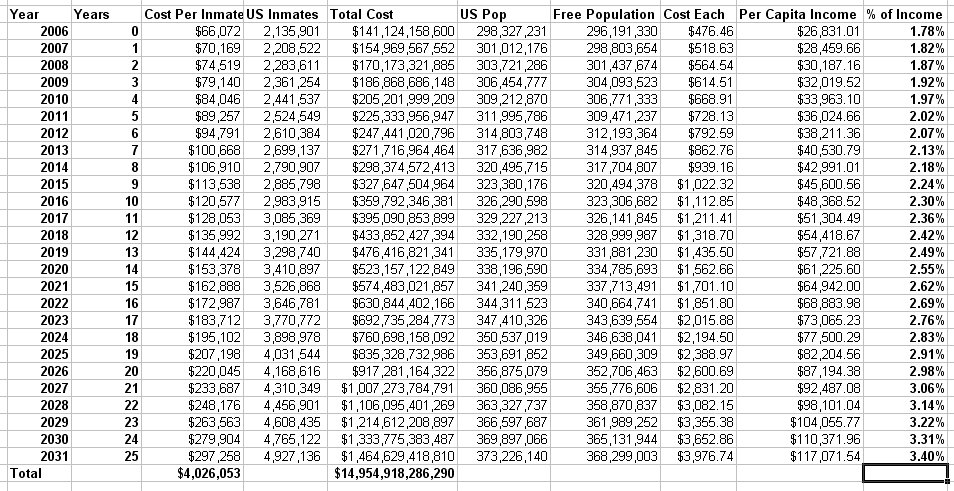
The prison system doesn't work. It is too cushy for prisoners, and costs taxpayers way too much. The government statistics I could find say that in 2005 there were 2,135,901 prisoners locked up in all federal, state, and local prisons, and that the long-term increase rate was 3.4% annually for prisoners in the system. The same federal statistics also said that in 2001 it cost an average of $134 a day for each state prisoner to house, feed, supervise, give medical care to, etc. It also said that the long-term average increase of those costs per prisoner were increasing at a rate of about 6.2% per year, about twice the rate of inflation. That would mean that this year it will cost about $181 a day to supervise an average state prisoner. Multiply the cost by the number and you get $141 billion spent by the federal government, all state governments, and all local governments. With 296,191,330 people in the US today and 2,135,901 of them in jail, that leaves 296,191,330 free men, women, and children in the country to each pay $476.46 this year alone for housing and supervising and feeding and giving medical care to those prisoners. That is 1.78% of the per capita (every man, woman and child in the entire country) income of Americans for this year.
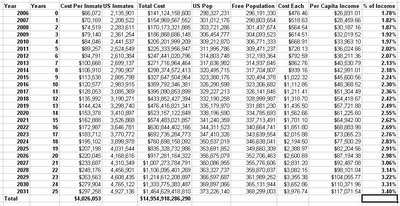
The worst part though, is that while inflation really is only about 3% a year, the cost per inmate is increasing by 6.2% per year, and the number of prisoners is growing at a rate of 3.4% per year while the US population is only growing by 0.9% per year, so the percentage of prisoners is getting higher. I put together a spreadsheet with all this data and the increase rates for the next 25 years, and it is very disturbing. If current rates that I found hold up over the next 25 years, then in 2031 it will cost $297,000 a year to take care of a prisoner, there will be almost 5 million prisoners, the total cost will be almost $1.5 trillion for that year, which will result in a cost per capita in the US of $3,976.74, or 3.4% of per capita in come, as compared to 1.78% today.
No, we need to trim down prisons, make them a punishment, not a benefit. There are too many people who don't care if they go back. Some people even commit crimes just to go back because it is a roof and 3 square meals they don't have to work for. Prison time should be hard, and uncomfortable, and unpleasant. The cost to taxpayers should be MINIMAL. Right now, we're not deterring crime with our prisons, which is why we are getting more of it. When people are afraid to go to prison, they think much harder about committing a crime. Think Soviet-era gulags here, but without the torture. Think small, basic solitary cells, basic food, no recreational facilities, TVs or the like. Almost no communication with other inmates or guards. Visiting days come once a month rather than once a week. Exercise time is spent alone, in a small courtyard. Meals are served in the cells, and they will be small (but healthy), as you don't need too much energy to sit around your cell all day. Approved books from a small collection in the prison is your only recreation in the cell, and these would all be educational books about real-life skills. Too many people don't have a fear of going to prison. We need to re-establish prisons as a deterrent, not as a convenient motel when you don't want to work.
The worst part though, is that while inflation really is only about 3% a year, the cost per inmate is increasing by 6.2% per year, and the number of prisoners is growing at a rate of 3.4% per year while the US population is only growing by 0.9% per year, so the percentage of prisoners is getting higher. I put together a spreadsheet with all this data and the increase rates for the next 25 years, and it is very disturbing. If current rates that I found hold up over the next 25 years, then in 2031 it will cost $297,000 a year to take care of a prisoner, there will be almost 5 million prisoners, the total cost will be almost $1.5 trillion for that year, which will result in a cost per capita in the US of $3,976.74, or 3.4% of per capita in come, as compared to 1.78% today.
No, we need to trim down prisons, make them a punishment, not a benefit. There are too many people who don't care if they go back. Some people even commit crimes just to go back because it is a roof and 3 square meals they don't have to work for. Prison time should be hard, and uncomfortable, and unpleasant. The cost to taxpayers should be MINIMAL. Right now, we're not deterring crime with our prisons, which is why we are getting more of it. When people are afraid to go to prison, they think much harder about committing a crime. Think Soviet-era gulags here, but without the torture. Think small, basic solitary cells, basic food, no recreational facilities, TVs or the like. Almost no communication with other inmates or guards. Visiting days come once a month rather than once a week. Exercise time is spent alone, in a small courtyard. Meals are served in the cells, and they will be small (but healthy), as you don't need too much energy to sit around your cell all day. Approved books from a small collection in the prison is your only recreation in the cell, and these would all be educational books about real-life skills. Too many people don't have a fear of going to prison. We need to re-establish prisons as a deterrent, not as a convenient motel when you don't want to work.
Subscribe to:
Posts (Atom)